Method
Transfert
Many answers to care already exist. They're just elsewhere.
Video games solved daily engagement better than preventive health. Luxury design understood user experience better than the hospital. Japanese robotics tamed technological presence better than Western medicine. The living offers patterns human systems ignore.
Why
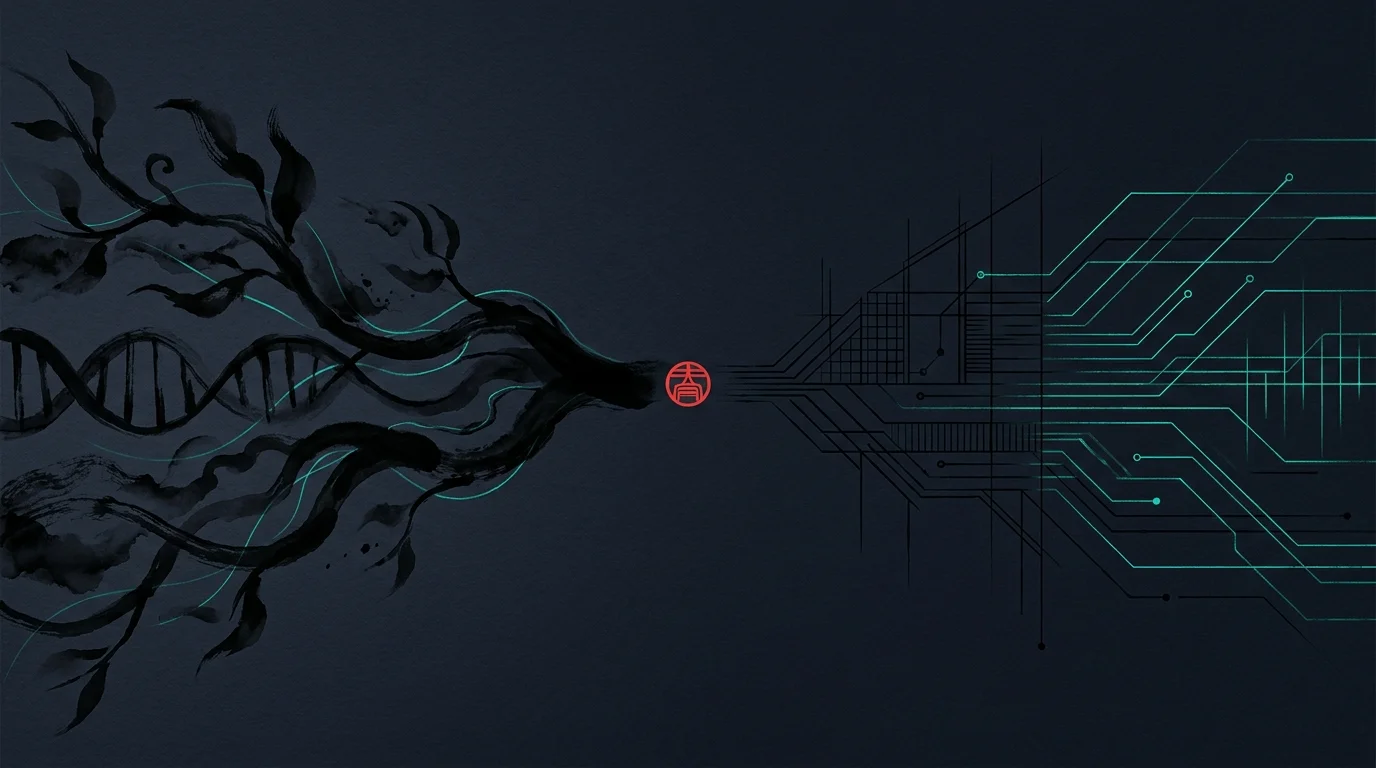
Medicine looks for answers inside itself. It's reassuring, but it closes the door on half of the good ideas. Other fields have solved, in their own way, problems medicine still carries. They don't even know it. It's by watching how they do it that paths open.
Miroki was born from a Japanese robot that handed me a towel in Tokyo. Each time, a detour through another world opened the solution. It isn't an accident. It's the method.
How
Every transfer follows the same path. Identify a pattern in a domain that has nothing to do with medicine. Understand what makes the pattern work where it was born. Translate that pattern into the vocabulary of care, respecting what care cannot betray.
Not every transfer holds. Some collapse in translation. Others become entire projects. Others remain sketches, intuitions. I publish all three. What counts is the workshop, not only what leaves it.
Transfers don't come only from professional fields. A whole culture, a tradition, a philosophy of space or time can carry a pattern no professional domain would hold. Japan, for instance, has resolved, in its own way, relationships to attention, to emptiness, to imperfection that Western medicine still handles awkwardly.
The domains I explore
- Affective robotics and human-machine interaction.
- Video games and gamification.
- The living: biology, ecology, metamodels of life.
- Cultures and philosophies (Japan, Stoicism, and others).
- And many others.
Frequently asked questions
What is the Transfert method?
Transfert is a method for taking a pattern that works in another domain (video games, luxury design, Japanese robotics, cuisine, living systems) and transposing it into healthcare. The idea: look for solutions where medicine does not usually look.
Why this approach?
Medicine often runs in a closed loop on its own references. Many problems of care pathway, patient experience or engagement have already been solved elsewhere, by industries that had decades to iterate. Transposing them is faster and more radical than reinventing.
Any concrete examples?
The Japanese ma (the empty space between things) transposed into the rhythm of a consultation. Game design loops applied to therapeutic adherence. Fine dining plating applied to presenting clinical results. The catalog keeps growing.
How do I use the method?
Each Transfert entry follows a reproducible 8-section format: context, source pattern, extraction, transposition, evidence or hypothesis, limits, application lead, resources. Journal articles are its living library.